

What is CRDP?
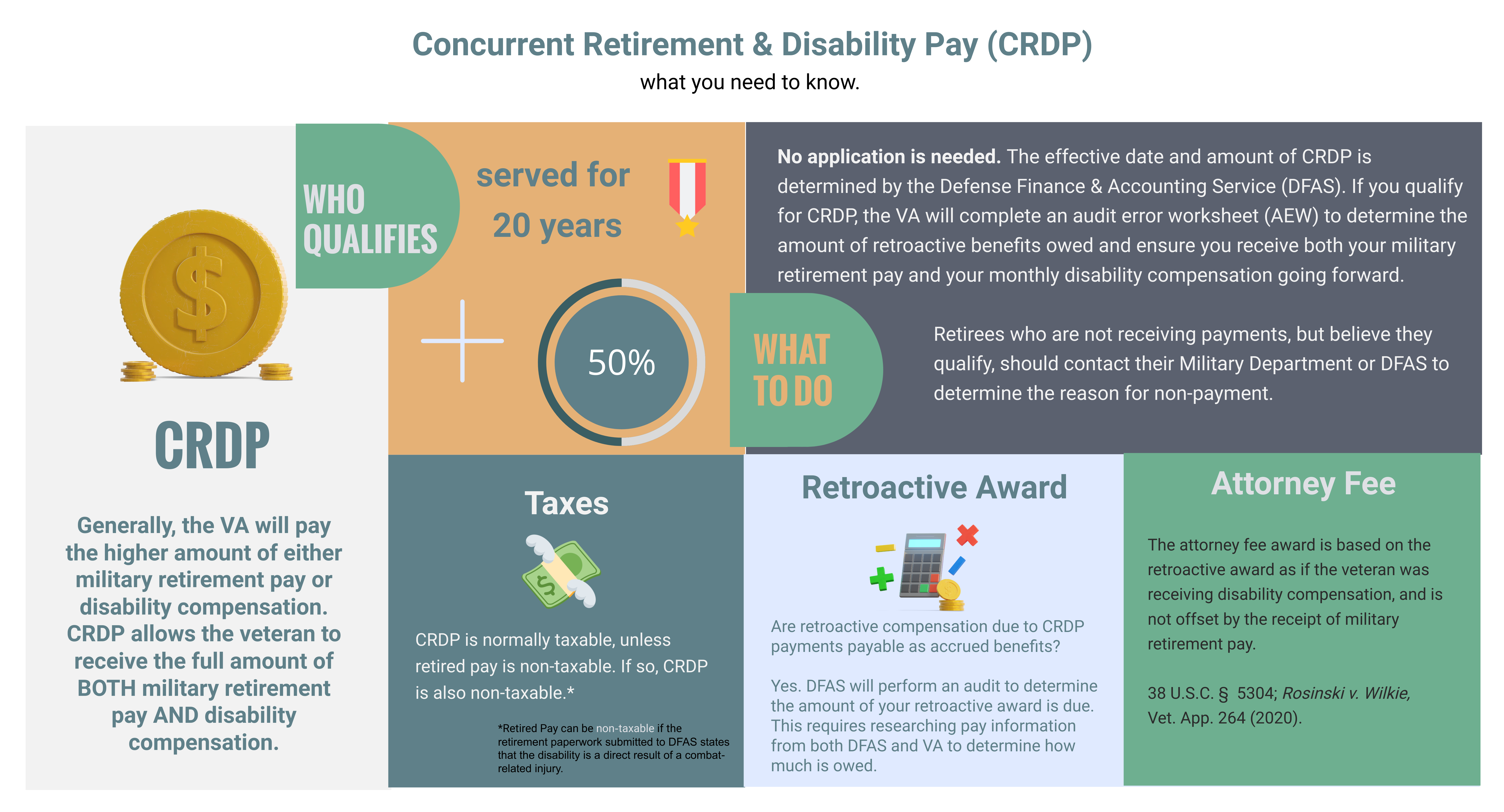
The National Defense Authorization Act of 2004 established CRDP, effective January 1, 2004. DoD is responsible for administering this program, the intended purpose of which was to phase out the offset of MRP for VA disability compensation over a 10-year period.
CRDP restores some or all of that portion of MRP a veteran waived in order to receive VA disability compensation.
CRDP is subject to all of the same laws and regulations that apply to MRP, including reductions for
taxes
child support or alimony
garnishments, and
government debts.
When Does It Apply?
Veterans may qualify for CRDP if they:
are a military retiree with a combined disability rating of at least 50%, and
meet one of the following requirements:
retired based on length of service (including veterans who were retired under the Temporary Early Retirement Authority (TERA));
retired based on disability (10 U.S.C. Chapter 61) with at least 20 years of active service; or
retired from a Reserve component with 20 qualifying years of service and has reached retirement age (generally age 60).1
How Does It Work?
DFAS handles most MRP accounts. At some Regional Offices, the same employee who serves as an RO’s Military Records Specialist may also serve as the RO’s MRP Coordinator. Regional offices (ROs) appoint someone to act as Military Retired Pay (MRP) Coordinator and serve as the authorization activity’s single point of contact (POC) for telephone inquiries to the Defense Finance and Accounting Service (DFAS).
MRP Coordinators are responsible for handling MRP inquiries for which a satisfactory response cannot be obtained through normal development procedures with a single phone call.
Whenever an RO adjusts an award, Department of Veterans Affairs (VA) computer systems automatically transmit data regarding the award adjustment to the appropriate RPC, regardless of the number of prior periods on the award.
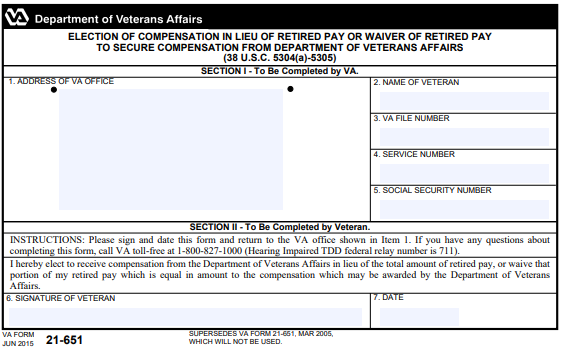
RPCs have a record of every veteran who signed a VA Form 21-651:
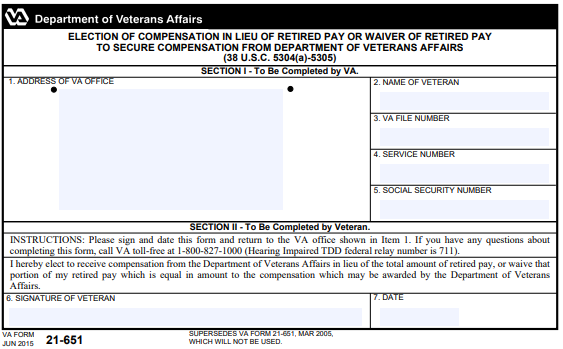
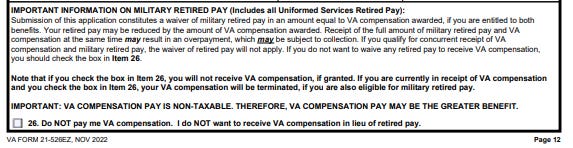
Per 38 CFR 3.750(c), a Veteran’s application for VA benefits on the 526EZ constitutes an election of VA benefits or a waiver of MRP in the absence of a specific statement to the contrary:
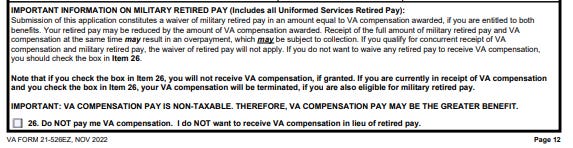
When the VA is processing the award notice, they are supposed to check and see if the veteran is receiving military retirement pay (MRP). If they can’t figure out whether the veteran is receiving MRP, they’re supposed to contact CGRASB at either 866-772-8724, or 785-339-2200 and ask them whether the amount of the veteran’s MRP has been calculated.
If the veteran is entitled to both MRP and disability compensation, the VA should open EP Code 298 - CRSC/CRDP Processing and create an audit error worksheet (AEW) and add Potential Under/Overpayment as a special issue.
An audit error worksheet (AEW) is a document containing data regarding a Veteran’s military retired pay (MRP) and entitlement to Concurrent Retirement Disability Pay (CRDP) or Combat-Related Special Compensation (CRSC).
Once the VA completes the audit, it will notify the veteran and adjust any associated awards as necessary.
What Do We Do?
If the veteran is entitled to both military retirement pay (MRP) and disability compensation because they are over 50% combined, the VA should open EP Code 298 - CRSC/CRDP Processing.
If they don’t open an EP Code by the time the decision notice goes out, send an e-mail to MILPAY.VBACO@VA.GOV with the subject line "CRP Processing EP Code” and includes the veteran’s claim number and request to open EP Code 298 - CRSC/CRDP Processing and request that the VA complete an audit error worksheet (AEW).
*use #CRDP in textexpander for the email template
Calculating Attorney Fees
Are retroactive compensation due to CRDP and CRSC payments payable as accrued benefits?2 The attorney fee should not be offset by the amount of retroactive award the veteran receives in accordance with 38 U.S.C. § 5304 and Rosinski v. Wilkie, 32 Vet. App. 264 (2020). Even if the VA can offset the amount of disability compensation because the veteran is receiving more money each month from their military retirement pay and they are not at 50% combined, if we are successful on appeal, the VA needs to award an attorney fee based on the retroactive award as if the veteran was receiving disability compensation.
Example:
We file a Supplemental Claim (0995) and the VA awards service-connection for PTSD at 10%, which brings his combined rating from 0% to 30% as of January 1, 2024. However, the veteran receives $600 monthly in military retirement pay (MRP), so the VA pays him MRP instead of disability compensation each month.
$524.31 per month (30% monthly disability comp rate for a single veteran) x 4 months (January - April 2024) = $2,097.48 x .20 (attorney fee)
= $419.50 attorney fee award
What to Do:
If the VA should have awarded an attorney fee because it was a win on an appeal or a Supplemental Claim (0995), check the attorney fee calculation spreadsheet in the veteran’s VBMS folder to make sure the VA awarded 20% of the retroactive award prior to the offset. If they did not, we need to appeal the fee decision within 60 days and cite to 38 U.S.C. § 5304 and Rosinski v. Wilkie, 32 Vet. App. 264 (2020).
Questions:
When does it apply? When should we be looking for it ?
Strategy Tab: we ask what other benefits the veteran is getting on intake, so if it’s a client we’ve onboarded since February 2024, it should say whether they’re receiving military retirement pay in the Strategy Tab, but if they served for 20+ years and they’re over 60, it’s always good to check with them again once they’re at 50% combined.
Is it only applicable when VA retirement at issue or also applicable with workers comp, social security ,etc. if not, is there anything else that offsets VA disability in those scenarios?
There are no offsets related to workers’ compensation, but there may be an offset for VA Pension if the veteran is also receiving SSI (income-based). There are no offsets for SSDI.
The VA may also offset a retro award if the veteran received separation or severance pay when discharged.* This should not affect our attorney fee (see Attorney Fee Section above).
Concurrent payment of both CRDP and CRSC may not be made. If a veteran is eligible for both CRDP and CRSC, they may elect either benefit during the election open season.
What are the #s /contact info at the VA that we should give to clients when this comes up / when should we give it to them? (before we file, during, after etc).
An application for CRDP is not necessary. Retired Pay Centers (RPCs) automatically determine the amount of CRDP to which a veteran was entitled and initiate payment to the veteran.
For questions about CRDP:
Defense Finance and Accounting Service
U.S. Military Retired Pay
8899 E 56th St
Indianapolis IN 46249-1200
Email: milpay.vbaco@va.gov
Phone: (800) 321-1080
Do we have any fact sheets on this we could email to clients, or any info we could put only a fact sheet for this?
If there are any offsets, or when they get to a certain %, will everything immediately go into effect?
For example, if client gets to 100% and gets retirement after their 25 years - will they receive both concurrently the month following the decision? If CDRP applies in multiple situations, same question for each.
Once the EP Code is established, it generally takes about 90 days for DFAS to complete the audit and issue the retro award for the full amount of both military retirement pay and disability compensation.
In most cases, the retirement age for reservists is 60, but some may start receiving MRP prior to age 60 under 10 U.S.C. 12731(f)(2)(A). Those with 20 qualifying years of service who are receiving disability retired pay prior to their retirement age are not entitled to CRDP. They may become eligible for CRDP when they reach their retirement age.
Answer: Yes, they are subject to 38 C.F.R. § 3.1000.